
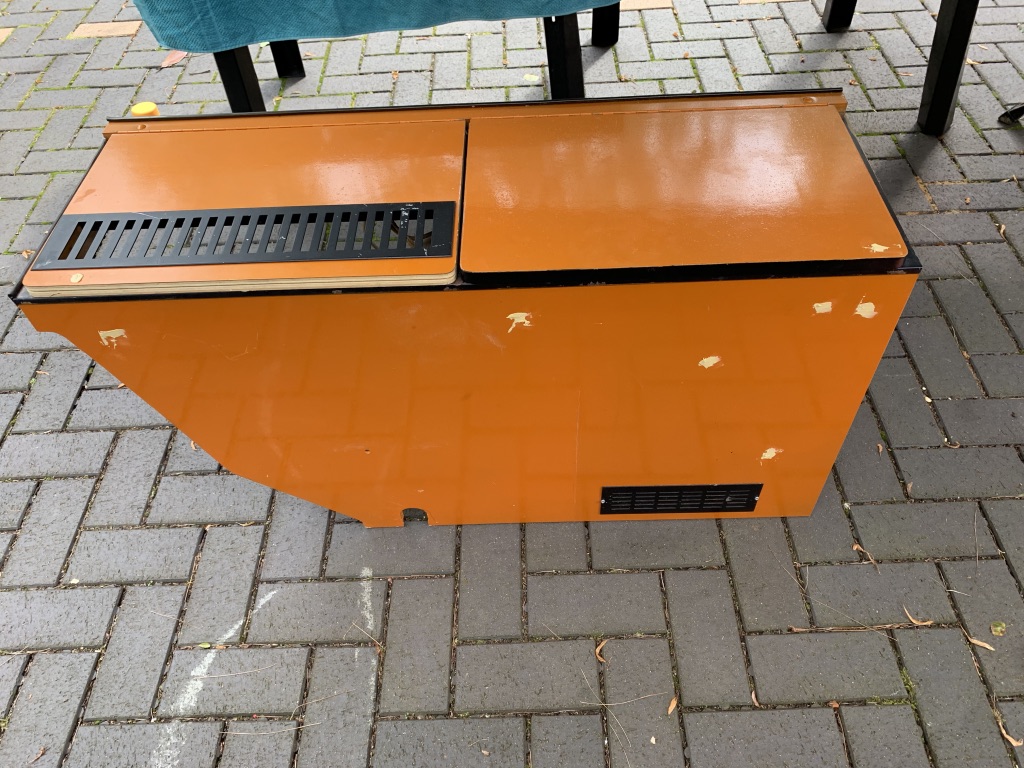
My van has the original Westfalia Wine Cooler (DOMETIC RC 152) still intact in the van. As with all things electrical I wanted to soak test this item and ascertain its reliability. After all, would you trust a 40 year old fridge in your kitchen? Probably not! One thing to note with this unit is, you cannot find any replacement parts, or for that matter a replacement fridge (well not the exact one). I did hunt around for a new version that would fit exactly into the Westfalia space and just came to a complete dead end (with the interior of the bus I was extremely keen on keeping it as original as I possibly could). The unit in my van is wired up via a 110v AC to 12v DC inverter. The van was probably an import from the USA (need to research???) and still has all of the USA electrics in it. I started by ripping this out – no point keeping 110v inverter kit in the UK – pointless!!! Once I had done this I connected my fridge up via the Westfalia distribution panel to my 12V leisure battery directly. On my panel this is connected via a switch and a 25 Amp fuse (which gave me some reassurance that once I began the test it would stop the bus from burning down if we had an electrical fault!). Once connected you should hear a faint but reassuring hum – this lets you know the fridge has come to life. Do not expect the loud noise that you get from your fridge at home, there is no compressor, the unit works by circulating ammonia. Once I connected power, the fridge kicked into life, but only after I put the thermostat on max. Came back 4 hours later and fuse blown, fridge not cold! After some further research (there is hardly anything out there on the internet) I discovered that the fridge is extremely prone to overheating if not tested on level ground (imagine a glass of water on a slope, now apply that principle to ammonia in a network of pipes at the back of your fridge!). My van is currently on very high rear axle stands due the engine overhaul. This caused the ammonia within it to overheat and almost certainly induced a huge current draw which caused the fuse to blow. Once I realised the cause I decided to remove the fridge and connect directly to 12v DC power supply and test on level ground out of the van (note: no in line fuses so keep a constant watch here). The power supply that I have, has an ammeter on the front, as soon as you turn up the thermostat you can immediately see the fridge draw current, if you have the same fridge this should be in the region of 4.5-5.5 Amps (very high see notes below on the implication of this). You will notice that this drops to zero when the fridge reaches the desired temperature. After just 3 hours my unit had cooled down a bottle of beer (yea!). I ran several tests on the thermostat which is working fully (again keep an eye on the ammeter and you will know if it is working or not). I then kept the fridge connected for 3 days to make sure that it was up to the task and all has worked perfectly. The photo below shows how I connected, note which cable is positive and which is negative. Apart from that simples!!!! NOTE: As mentioned above the fridge draws 4.5 amps when on. If connected to standard car battery you can do a little math and you will realise that a battery is not going to keep this unit going for long. Here is how to work it out:
Voltage =12V Amps = 4.5 So, Power = VxI = 54 Watts
A battery is rated by Ampere Hours to ascertain run time you use the following formula:
Run Time = (10xAh of Battery)/Watt of Appliance so for a 100Ah battery
(100×10)/54 = 18.5 hours
IT DOES NOT TAKE A GENIUS TO WORK OUT THAT YOU ARE NOT RUNNING THIS FRIDGE FOR A WEEKEND ON YOUR LEISURE BATTERY ALONE (NOTE: FRIDGE DOES NOT DRAW POWER CONTINUOUSLY SO ALLOW MORE THAN 18 HOURS) – THEY ARE NOT CALLED BATTERY KILLERS FOR NOTHING!!!

 SPARKY'S VAN